Product Overview

Canary Carbon Emission Monitoring and Decision Management System is the world's and the industry's first general dual-carbon management system.

What cannot be measured cannot be managed; monitoring is the foundation of all work. As the roadmap for 'carbon peaking and carbon neutrality' becomes clearly defined, dual-carbon will become an unavoidable element in future work. With no clear standards yet available from governments or the industry worldwide, through policy research, scientific research, and practical evaluation, we took the lead in launching the 'Canary Carbon Emission Monitoring and Decision Management System' to establish a carbon emission data collection system, which is the key and hub for achieving the dual-carbon goals. We explore the establishment of a scientific and refined carbon emission accounting system and contribute to building a solid foundation for dual-carbon work.

The Government Edition is designed for government agencies at all levels for basic monitoring and processing of dual-carbon work within their jurisdictions, enabling coordinated monitoring of regional carbon emissions and providing a decision-making tool for subsequent dual-carbon work and policy command and dispatch. It assists relevant departments in macro-level decision-making such as formulating regional energy-saving and emission-reduction plans, total energy consumption and intensity ('dual control' assessment), project investment budgets, carbon emission rights, and carbon verification.

The Enterprise Edition focuses on accurate measurement of energy consumption data of energy-using equipment within enterprises, further exploring potential energy-saving space and retrofit opportunities, thereby achieving energy saving, consumption reduction, quality improvement, and efficiency enhancement.

The Government Co-governance Edition focuses on unified governance within government jurisdictions, activating broad public support for and response to dual-carbon work, encouraging active participation, and working together to achieve the dual-carbon goals. Residents earn carbon points through activities such as waste sorting and green travel, sell points in the points mall for cash or benefits, and increase residents' enthusiasm for participating in energy saving and emission reduction.

The Government Support Edition is provided free of charge to economically disadvantaged regions with high energy consumption intensity, helping to achieve regional dual-carbon goals and accelerate regional economic transformation. Let us work together to build green mountains and clear waters.
Product Advantages

The system has the following features:

1. It can monitor electricity consumption, water consumption, and gas consumption for multiple key industries and equipment in urban areas, and can record total energy consumption, power, and electricity consumption.

2. Through the system, data can be remotely transmitted to the client, and multiple energy-use conditions in industry can be viewed via mobile phones. It can generate databases and produce multiple reports, charts, etc., providing real electricity consumption data for production management.

3. It uses big data analysis and assessment to provide users with decision support.

4. It can analyze data obtained from metering instruments, allowing viewing by any year, month, or day, and enabling users to conduct real-time monitoring for any time period.

5. It supports city-level data upload on the platform. It connects with the national platform according to unified technical standards and provides support services to relevant provincial departments and key energy-using units.

Product Functions

The basic version has the following functions:

1. 'Carbon emission' data access, governance, and data integration
Using manual entry and advanced IoT technologies, it fully integrates various data resources from fields and departments such as electricity, petroleum, natural gas, new energy, environmental protection, forestry, the Internet, and government agencies. Through big data technologies and tools, it achieves professional data governance and data integration analysis and rationally allocates carbon emission quotas for various industries and regions.

2. 'Carbon emission' monitoring and intelligent analysis
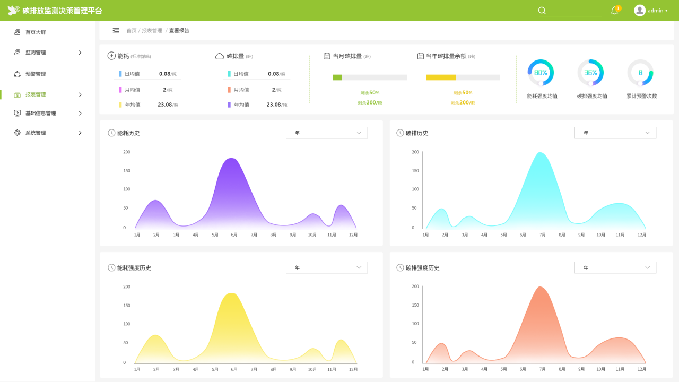
From dimensions such as energy structure composition, output trends, and consumption changes, and integrating multiple perspectives such as energy industry, type, time, and region, it builds carbon emission distribution analysis views to achieve all-round, multi-dimensional, and multi-perspective analysis. Combining information on clean energy alternative technologies, it conducts correlation analysis and correlation mining on clean energy consumption data, non-fossil energy consumption data, population carbon footprints, energy-saving and emission-reduction policies, energy-saving awareness, and forest coverage, and identifies key factors affecting carbon emission reduction. It conducts carbon emission monitoring and decarbonization potential analysis for key industries, as well as carbon trading and carbon pricing analysis, achieving comprehensive dimensional analysis of regional overall carbon production, consumption, alternative resources, and carbon reduction channels, and performs situational awareness and accurate forecasting of future trends.

1640075182_.jpg

3. 'Carbon emission' visualized dispatch and command
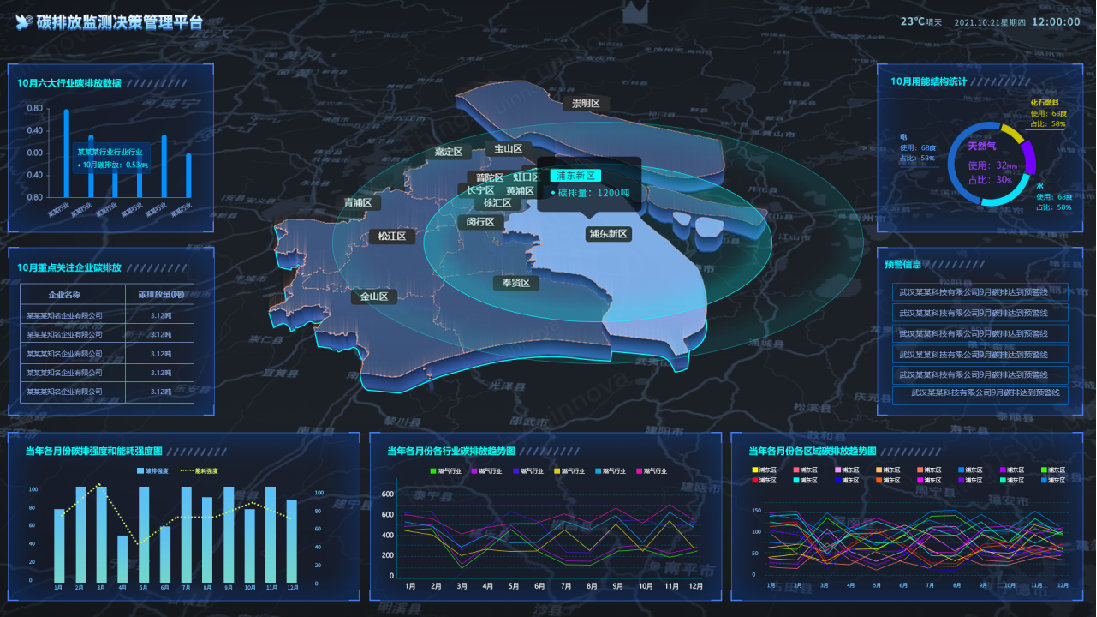
The platform monitors the implementation results of 'carbon neutrality' through channels such as intelligent monitoring, uses big data analysis technology to analyze regional multi-dimensional indicators, simulates carbon neutrality scenarios through intelligent means, builds thematic application scenarios for carbon neutrality and carbon emission reduction, and predicts and dynamically simulates future key indicators and data affecting carbon peaking and carbon neutrality. Enterprises can dispatch carbon emissions to relevant departments and regions. Government departments can conduct overall management of industry and regional carbon emission distribution combined with multiple factors such as GDP impact, and carry out dispatch, command, and optimization adjustments for relevant enterprises, departments, and fields to ensure the achievement of carbon neutrality goals.

4. 'Carbon points' mall transactions

Obtaining carbon points:
Residents can register through mini-programs and submit video or photo evidence for activities such as waste sorting and green travel, or apply for carbon points through data integration with third-party platforms. After review by the management platform, corresponding carbon points are issued to users.

Purchasing and redeeming carbon points:
Enterprises in six major categories whose carbon emissions exceed standards need to purchase carbon points from the carbon points mall to reduce fines.
Residents can sell points through the carbon points mall for cash or directly redeem points for benefits.
Blockchain technology is enabled to ensure fairness of carbon points and the immutability of rights and benefits.

Large Screen Display

1640075610_in.jpg

Frequently Asked Questions

Q1: Government Edition, Enterprise Edition, Co-governance Edition, Support Edition—which one should we choose?

A: It depends on who will use it: those managing dual-carbon work within a jurisdiction should choose the Government Edition; enterprises managing factory areas should choose the Enterprise Edition; those engaging residents in carbon reduction should use the Co-governance Edition. Regions with high energy consumption intensity and tight budgets can apply for the Government Support Edition.

Q2: The Government Support Edition is provided free of charge. What are the conditions for application?

A: It is provided free of charge to regions with high energy consumption intensity and great pressure for economic transformation, to first establish a local carbon data ledger. To apply, contact SEEMSE (Jinzhang Technology) for an assessment and confirmation of the applicable region; no fee is charged.

Q3: How does the carbon points mall operate, and what do residents and enterprises each do?

A: Residents sort waste and travel green, upload photo or video evidence in the mini-program, and receive carbon points after review. Points can be exchanged for cash or benefits. Enterprises whose emissions exceed standards can buy points to offset emissions, and blockchain accounting is used for circulation to prevent repeated use.

Q4: What data can the system provide for the 'dual control' assessment and regional emission reduction plans?

A: The system aggregates regional energy consumption and carbon emissions by industry, region, and time, providing data support for regional energy-saving and emission-reduction plans, energy consumption dual control assessments, and carbon emission rights management. Indicator recognition ultimately follows the competent authorities' criteria, and the system is responsible for making the ledger accurate.

Q5: Should data be reported to the provincial and national platforms, and according to what standards should it be connected?

A: Yes, or it can remain only within the jurisdiction. The system supports city-level direct data upload on the platform and connects with the national platform according to unified technical standards, while providing data services to relevant provincial departments and key energy-using units.