


The Dragonfly AI Edge Computing Server is a self-developed lightweight, intelligent, edge-deployable intelligent terminal for video detection and recognition. The system is designed for the video and surveillance fields and comes with a powerful AI algorithm engine. It supports flexible deployment of various recognition algorithms from the cloud and is positioned as an integrated hardware and software product for broad security applications. AI chip + AI framework + AI algorithm work together to provide strong and flexible AI computing power support, enabling intelligent analysis of high-channel-count video. It quickly implements AI applications such as facial recognition, license plate recognition, person and vehicle management, perimeter alerting, and smoke and fire alarms (implemented through cloud deployment), providing users with cost-effective intelligent solutions. It is widely used in various broad security application scenarios such as parks, campuses, construction sites, and communities.


Product Introduction
Product Features
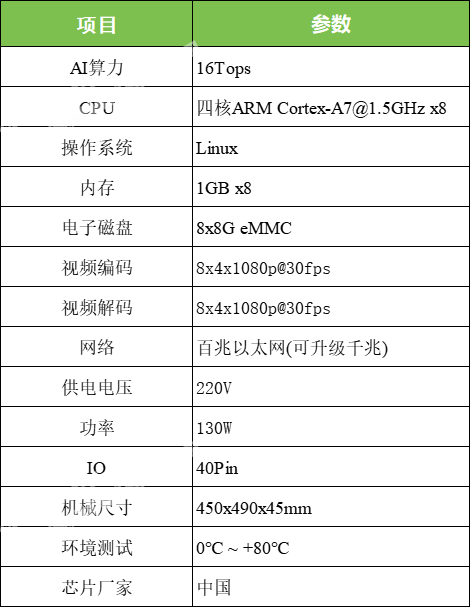
1. Standard 1U data center server, convenient for rapid installation and implementation;
2. A single server supports 32 video channels and can run 32 AI algorithm recognitions in parallel;
3. Supports the general RTSP protocol and both H264/H265;
4. It can be connected for detection within the same LAN as the NVR or cameras, reducing server load and traffic costs;
5. Supports lightweight detection alarm messages that are pushed to users in real time;
6. Detection devices are connected to unified cloud management for status viewing and detection task assignment;
7. AI models are managed uniformly in the cloud for convenient and flexible allocation and rational resource utilization;
8. Supports direct viewing of surveillance video, enabling interaction between risk monitoring and video surveillance;
9. Built-in AI algorithm engine, combined with the cloud, enables unlimited and flexible deployment of AI algorithms for any future business requirement;
10. Lightweight AI models with fast computing speed;
11. The unique 'edge-cloud' instant interconnection design architecture realizes resource sharing between edge and cloud, breaks through edge-side resource limitations, and enables system-wide resource sharing;
12. Provides rich RESTful API protocol interfaces, facilitating third-party integration development and rapid business integration;
13. The system supports both public cloud and private cloud deployment, following business development needs.
Technical Specifications
Application Introduction
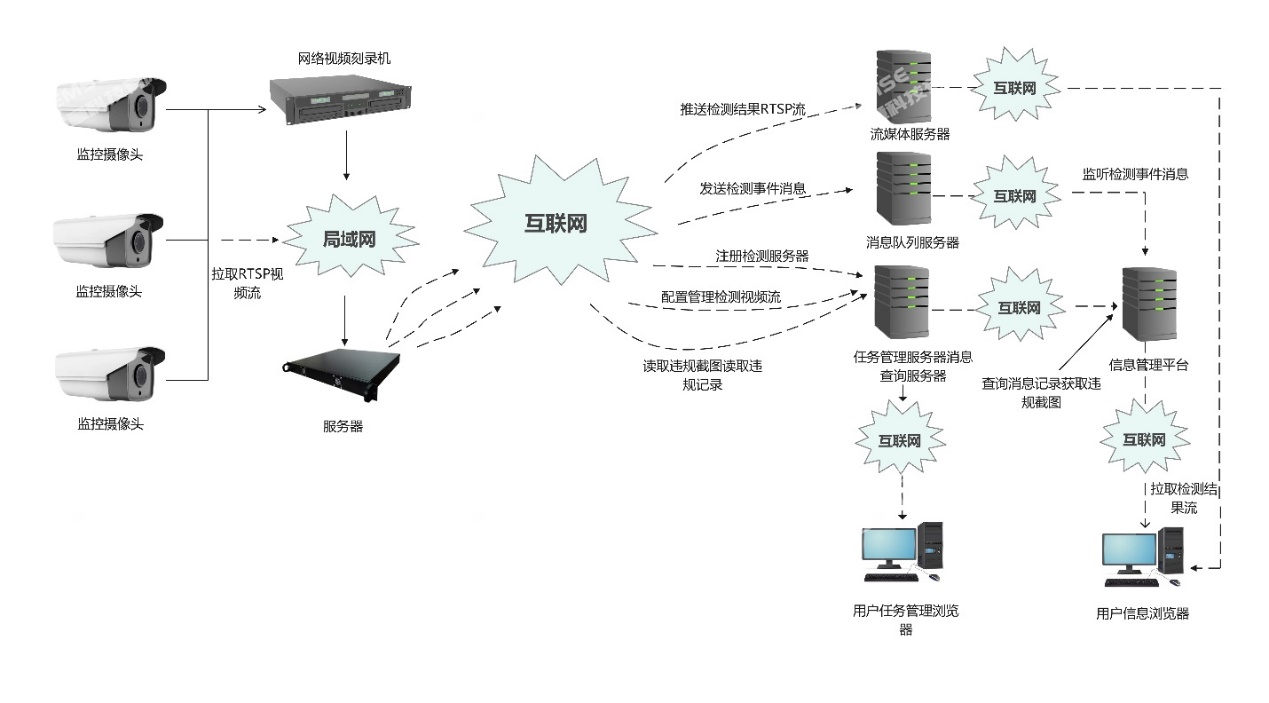
The Dragonfly AI Edge Computing Server connects directly to network video cameras, pulls video streams within the LAN, performs intelligent analysis and processing at the terminal, and uploads detection results to the cloud, reducing users' network bandwidth costs. It is flexible, convenient, and easy to deploy. The business process is as follows:
1. The detection server and the NVR of the surveillance cameras are placed on the same LAN, and streams are pulled directly from the NVR;
2. The detection server automatically connects to the task management server to receive management and task assignment;
3. The detection server sends detection events to the message queue server in real time for real-time listening by the user information platform;
4. The detection server can generate result videos and push them to the streaming media server for viewing by the user information platform;
5. The task management server provides a web platform for user operations and provides message record query interfaces and violation screenshot interfaces for the user information platform to call;
6. The streaming media server provides distribution of detection result video streams;
7. The message queue server provides distribution of real-time detection events.
Application Scenarios
1. Smart Parks: Based on standardized access data from intelligent devices/systems in the park, combined with technologies such as artificial intelligence, big data, and computing, it realizes a comprehensive operation and management platform for scenarios such as park personnel, vehicles, energy, security, assets, and environment. This helps improve operation and management efficiency, enhance park service quality, improve park safety management, and maximize the value of various intelligent systems in the park.
2. Smart Construction Sites: Through various monitoring devices installed at construction work sites, the AI recognition and analysis system builds an intelligent monitoring and prevention system, enabling all-round real-time monitoring of people, machines, objects, materials, methods, and environment. It can effectively compensate for the deficiencies of traditional methods and technologies in supervision, transforming passive 'supervision' into active 'monitoring,' truly achieving pre-warning, routine detection during the process, and standardized management afterward, and bringing information-based management to construction site safety production.
3. Smart Communities: Apply software and hardware to smart community scenarios to meet needs such as face-scanning access, stranger recognition, loitering detection, and entrance/exit management, satisfy the supervision requirements of public security and community subdistricts, improve community personnel management efficiency, and increase resident satisfaction. For illegal groups (fugitives) and key petitioners, carry out monitoring and management of key personnel.
4. Safe Campuses: AI Safe Campus is based on a cloud platform + business systems + AI facial recognition intelligent hardware terminals, forming full-stack intelligent services covering big data decision-making, security risk prevention and control, school gate management, dormitory management systems, cafeteria consumption, cloud class boards, smart office, and many other applications. It can provide education regulatory departments, schools, teachers, students, and parents with comprehensive, one-stop intelligent safe campus solutions.
5. Other scenarios requiring AI recognition and analysis.
FAQ
Q1: How are the hardware specifications and processing capabilities of the Dragonfly AI Edge Computing Server?
A: Standard 1U rack-mounted equipment; a single unit supports up to 32 video channels and can run 32 AI algorithms simultaneously. It is compatible with H.264 and H.265 encoding and can directly connect to existing cameras and NVR devices.
Q2: How does the Dragonfly AI Edge Computing Server connect to existing surveillance systems?
A: It is deployed on the same LAN as the cameras and NVR to pull video streams, without transmitting original video to the cloud, effectively saving bandwidth overhead. The analyzed alarm events are then uploaded to the business platform.
Q3: What algorithms does the Dragonfly AI Edge Server support, and how are they updated?
A: It supports recognition such as facial recognition, license plate recognition, smoke and fire, and boundary crossing. AI models are managed and delivered uniformly from the cloud. New algorithms can be added later without changing local hardware, flexibly adapting to business changes.
Q4: Is the Dragonfly AI Edge Computing Server easy to integrate with third-party business platforms?
A: It provides RESTful API interfaces and supports both public cloud and private cloud deployment modes. Alarm messages, screenshots, and recordings can all be output externally, facilitating integration development with customers' existing platforms.
Q5: What are the benefits of the edge-cloud architecture of the Dragonfly AI Edge Computing Server?
A: Video analysis is completed on the edge side, while the cloud handles task scheduling and model management, realizing resource collaboration between the two sides. Even if the external network is unstable, local video analysis tasks can still continue to run.