Q1: We have already deployed shared e-bikes of multiple brands. Do we need to replace all vehicle terminals before connecting to the platform?
A: There is no need to replace the whole vehicle. As long as the vehicle terminal supports a standard communication protocol, it can be directly connected for unified platform management; for some old terminals with incompatible protocols, you can evaluate replacing the on-board smart terminal while keeping the original body and battery, protecting existing project investment.
Q2: Which brands of shared e-bikes are supported? Can vehicles of other brands added later be connected?
A: It is compatible with mainstream shared e-bike smart terminals on the market and supports common IoT protocols. The platform adopts a modular access architecture; when different brand vehicles are added later, they can be quickly connected once protocol adaptation is completed, without rebuilding the entire system, which facilitates business expansion.
Q3: After multi-brand vehicles are connected, will positioning, order, and battery data be counted in a mess?
A: The platform performs standardized parsing of data reported by different terminals, unifying the data definitions of location, orders, riding duration, battery level, and revenue. It supports data filtering and statistics by city, zone, brand, and individual vehicle, and automatically outputs operation and reconciliation reports, solving the problem of data fragmentation across multiple systems.
Q4: Do control functions such as electronic geofences, no-parking, and speed limits work for vehicles of all brands?
A: Provided the terminal hardware supports it, electronic geofence parking areas, no-parking areas, regional speed limits, and return constraints can be configured uniformly. Joint debugging and testing will be completed during the integration phase; for old terminals with insufficient hardware capability, some functions will be limited by the hardware itself.
Q5: Do users need to download multiple APPs or mini programs?
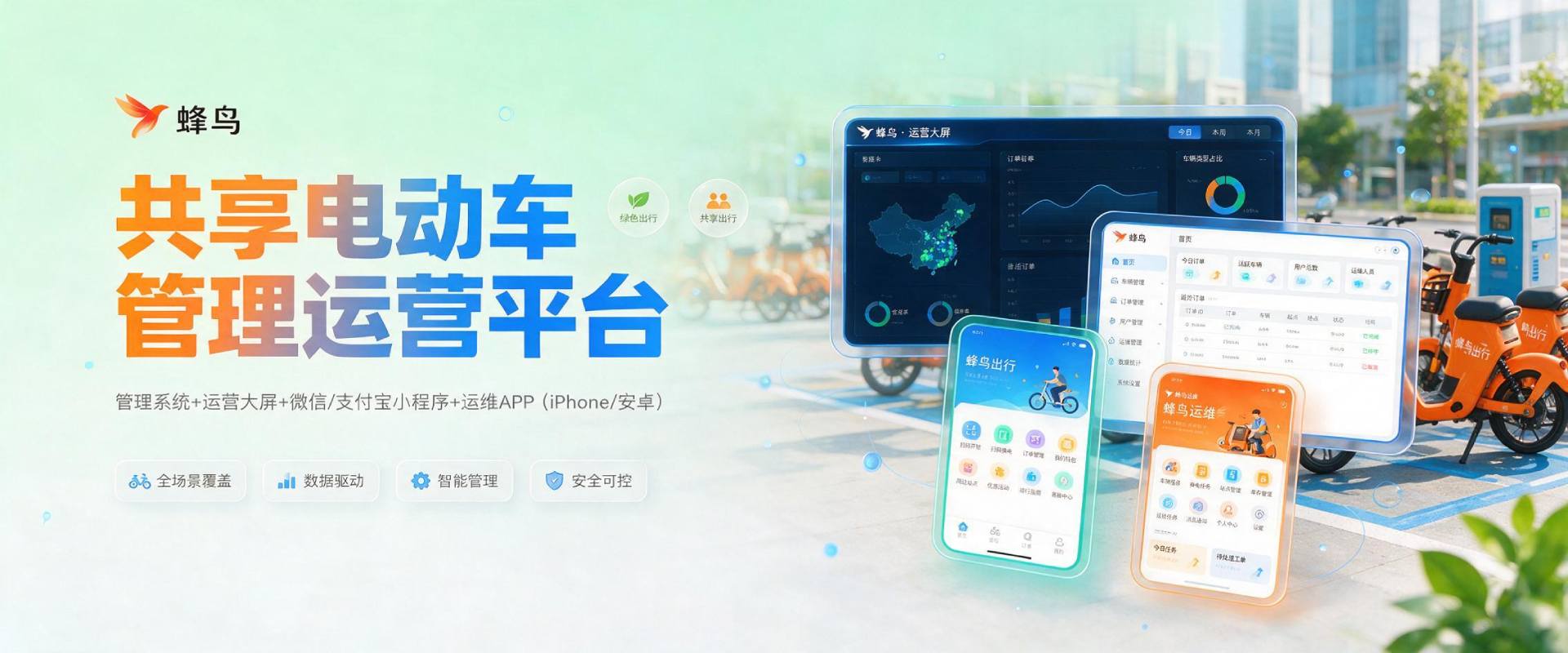
A: No. All shared e-bikes connected to the platform share one WeChat mini program; users can scan the code to unlock and ride, with support for top-ups, riding packages, order queries, and fault reporting, without switching between clients of multiple manufacturers.
Q6: How is O&M battery swap scheduling implemented?
A: The platform collects vehicle positioning, remaining battery power, and fault status in real time, automatically screens low-battery, faulty, and illegally parked vehicles, generates dispatch and battery swap work orders, and assigns them to O&M personnel; it supports O&M personnel to accept orders and complete check-in closed loops on mobile, realizing full online O&M processes.
Q7: After connecting to the platform, can the original vehicle manufacturer's backend still be used?
A: Dual-backend parallel operation is supported; vehicle data can be synchronized to the original manufacturer's backend without affecting original factory hardware maintenance.
Q8: Can it connect to government regulatory platforms?
A: In accordance with local travel regulatory requirements, data such as vehicle location, order records, deployment scale, and fault alarms can be reported, meeting the supervision and filing requirements of the shared e-bike industry; it is suitable for city investment state-owned enterprises and urban public travel projects.
Q9: What deployment methods are available?
A: Public cloud, private cloud, and on-premises deployment are supported; for state-owned enterprise and government projects, local data retention can be supported to meet data security requirements.
Q10: How long does the integration and launch cycle take?
A: For terminals with standard protocols and complete materials, joint debugging and launch can be completed quickly; for terminals with private protocols, the equipment manufacturer needs to cooperate in opening the protocol, and the implementation cycle will be assessed according to actual conditions.